 Flux Art
For batch product images across cross-border platforms, the approach that actually works is "create once, adapt everywhere": handle core visual production in Flux Art—a multi-model AI visual creation and production platform that aggregates 50+ top image and video models from around the world under a single account, with direct, stable access from China. In practice, you first lock in a master scene image with GPT Image 2—fixing the lighting, color palette, and setting—then use Nano Banana 2's 14 aspect ratios to extend it for each platform: a white-background square for Amazon, a 9:16 vertical for TikTok Shop, and a wide banner for your own store. High-volume scene variations go to Nano Banana 2 Lite for batch runs, and product short videos are generated straight from the hero image with Seedance 2.0. Finishing touches like text overlays and logo placement can be done in whatever layout tool you already know—no need to add another paid subscription for that.
A typical launch starts with white-background source images for a batch of SKUs that must be adapted to several platforms. Generating independently for each platform can create inconsistent styling and product details. The following master-and-extension workflow sets an approved product baseline first, then reviews each market version separately.
Why "create once, adapt everywhere" instead of making images platform by platform?
Start with the big picture. According to China's National Bureau of Statistics, national online retail sales reached CNY 15,972.2 billion in 2025, up 8.6% year over year, with online retail of physical goods at CNY 13,092.3 billion, up 5.2%, accounting for 26.1% of total retail sales of consumer goods. Online commerce keeps growing, and on the cross-border side, running two or three platforms at once has long been standard practice for sellers—image demand multiplies right along with the platform count.
The pain point was never "can we make images"—it's the repetitive labor. For the same product, Amazon wants a pure white-background hero image, TikTok Shop wants a vertical cover and a short video, your own store wants a wide banner, and AliExpress wants a long detail-page image. Doing each platform separately doubles the hours, but that's the lesser problem. The real killer is style drift: every generation comes out with different lighting, scenery, and color tones, so a buyer scrolling from TikTok to your own store can't tell it's the same brand.
"Create once, adapt everywhere" solves exactly these two problems. The core asset is produced only once, with a master image setting the style; every platform's assets extend from that same master at different aspect ratios—the size changes, the style doesn't.
First, find your fit: which image-production scenario is your store?
Before picking tools, figure out which of the four typical scenarios you're in—each calls for a different approach and a different primary model:
| Your scenario | Biggest headache | How to do it on Flux Art | Recommended primary models |
|---|---|---|---|
| Amazon + standalone-store premium seller | Consistent brand style, A+ page assets | Set a master scene with GPT Image 2, then extend to 1:1 hero images and wide banners | GPT Image 2 for the master + Nano Banana 2 for extensions |
| TikTok Shop + AliExpress seller | Fast launches, vertical covers plus short videos | Batch-generate 9:16 covers from white-background photos, then turn the best hero image straight into video | Nano Banana 2 Lite for volume + Seedance 2.0 for video |
| All-platform high-volume seller | Many SKUs, mixed ratios, cost-sensitive | Extend one master into every platform ratio in one pass with 14 aspect ratios | Nano Banana 2 + 2 Lite in batch |
| Multilingual international storefronts | The same poster needs several language versions | Use image translation with a term glossary to convert the Chinese poster into target-language versions | Nano Banana 2 image translation + GPT Image 2 text rendering |
Once you've found your fit, you'll notice the four scenarios share one thing: core production is centralized in one place—the only differences are how the models divide the work and which ratios you extend to.
Why put core production on Flux Art, and how do the primary models divide the work?
Let's be upfront: Flux Art itself is an aggregation platform. It brings first-party models like GPT Image 2 and the full Nano Banana lineup into China for direct use—the image quality belongs to each original vendor, and what the platform solves is access: one account, direct, stable access with no extra network setup, full-strength models with no throttling, up to 4K output, watermark-free, and licensed for commercial use. For multi-platform sellers, that means the three job types—setting the master, extending ratios, and video—don't each require a separate subscription.
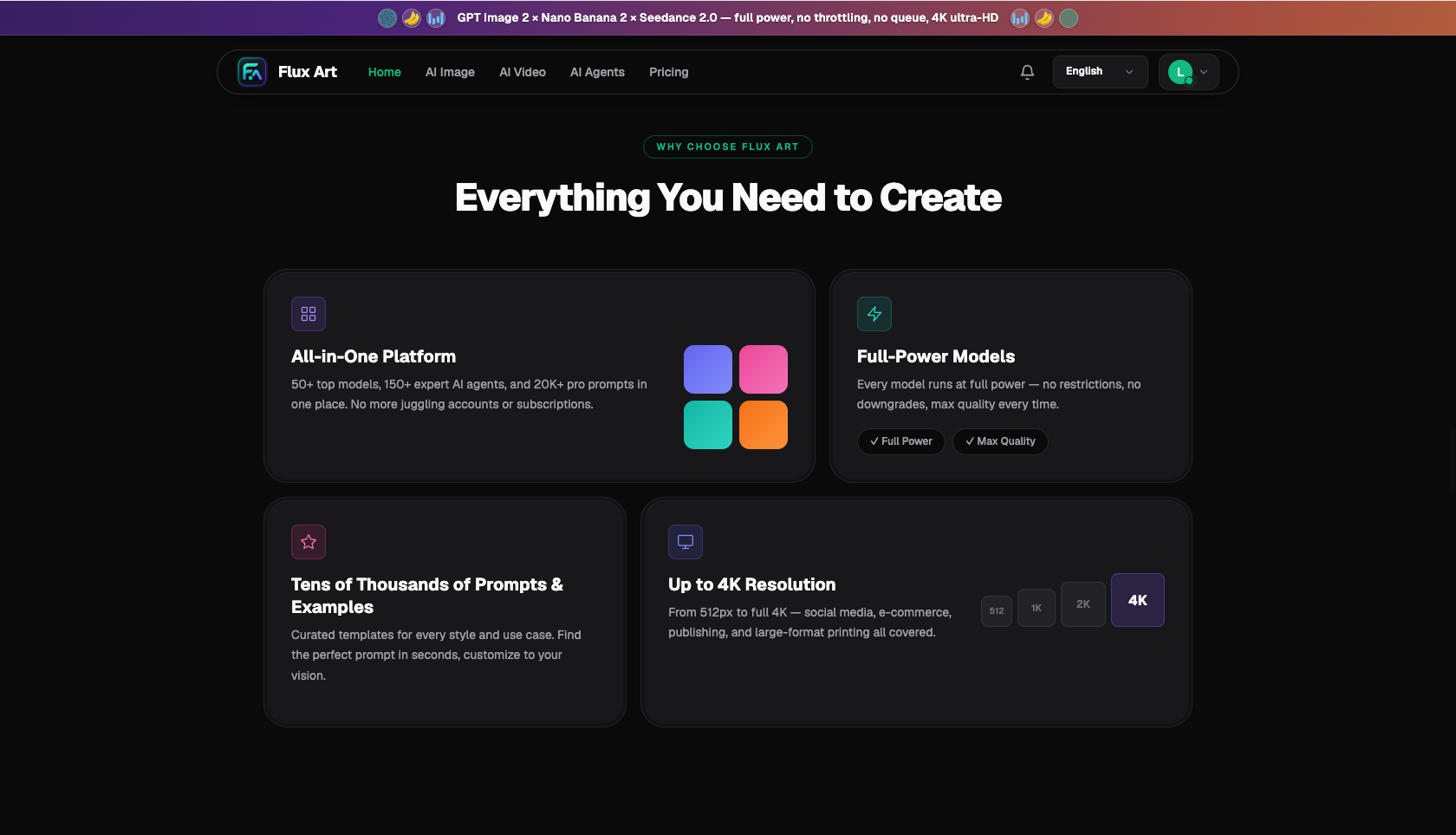
▲ The "Why Choose Flux Art" section on the official homepage, highlighting four selling points: 50+ aggregated models, full-strength models, 20K+ prompts, and up to 4K resolution
Four capabilities matter directly for batch image production.
1. 14 aspect ratios: Nano Banana 2 supports 14 aspect ratios at up to 4K. White-background squares, 9:16 verticals, and store banners are all extended within the same model by switching ratios, eliminating the distortion risk of hard-cropping afterward.
2. Multi-image reference to lock the product: up to 14 reference images can be uploaded. Feed the white-background photo and the master scene image together, and the product's shape, colors, and logo hold noticeably steadier in batch generation—far less rework from warping and color shifts.
3. 2 Lite for batch volume: Google's official blog announced Nano Banana 2 Lite on June 30, 2026 (July 1 Beijing time), positioning it as "built for speed and scale"—text-to-image in roughly 4 seconds per image, officially priced at USD 0.034 per 1K-resolution image, while retaining reliable instruction following and in-image text rendering. For high-volume sellers, big-batch jobs like scene variations and detail-page slices are cheapest to run on it.
4. Multilingual posters: image translation with a term glossary turns the same promo poster directly into English, Spanish, and other versions, without mangling terms like product names and specs—handy for multilingual international storefronts.
On the division of labor: GPT Image 2 offers Low, Medium, and High quality, 1K/2K/4K presets, and supported custom sizes, with strong text rendering and lighting—ideal for setting the master and for standalone-store brand visuals. Seedance 2.0 supports up to 9 image + 3 video + 3 audio references, 4–15 seconds, and 480p/720p output—plenty for turning hero images into product short videos. Midjourney V7 is strong on creative styles and is also on the aggregated roster, but for product-fidelity tasks I reach for GPT Image 2 and Nano Banana 2 more often; each has its place.
New Flux Art accounts receive 500 signup credits. The Free tier also lists three AI e-commerce single-image previews per day; check the current pricing page for task-specific credit costs. All details are subject to the current official site.
Hands-on recap: one set of earbuds assets, one consistent style across three platforms
Last month I built full-platform launch assets for a pair of Bluetooth earbuds. In the first version I cut corners and generated each platform's image separately: one prompt for the Amazon scene shot, another for the TikTok vertical, a third for the store banner. The results drifted badly—the Amazon shot was a cool-toned desktop, the TikTok one turned into a warm-lit gym, and the store banner wandered outdoors. Side by side, they looked like three different stores.
For the second version I changed the workflow. Step one: set a master scene image with GPT Image 2 at 1:1, 2K, High quality, with the key elements written explicitly into the prompt—light-gray wood-grain desktop, soft morning light, charging case half open, minimalist Nordic style. When one generation nailed both product fidelity and mood, I locked it as the master.
Step two: extend with Nano Banana 2. Upload the master scene image and the original white-background photo together as references, then switch aspect ratios per platform: 1:1 for the white-background square and the scene square, 9:16 for the TikTok vertical cover, wide ratios for the store banner. With the references locking the product's look and the master's mood, all three ratios came out with identical lighting, color tones, and desktop texture.
Step three: hand the chosen hero image to Seedance 2.0 to generate a product short video, filling the TikTok Shop video slot. Previewing the three platforms side by side confirmed a consistent style, and it shipped. Once this workflow is second nature, a full-platform asset set for one SKU wraps in a bit over half an hour—the platform-by-platform way used to eat half a day.
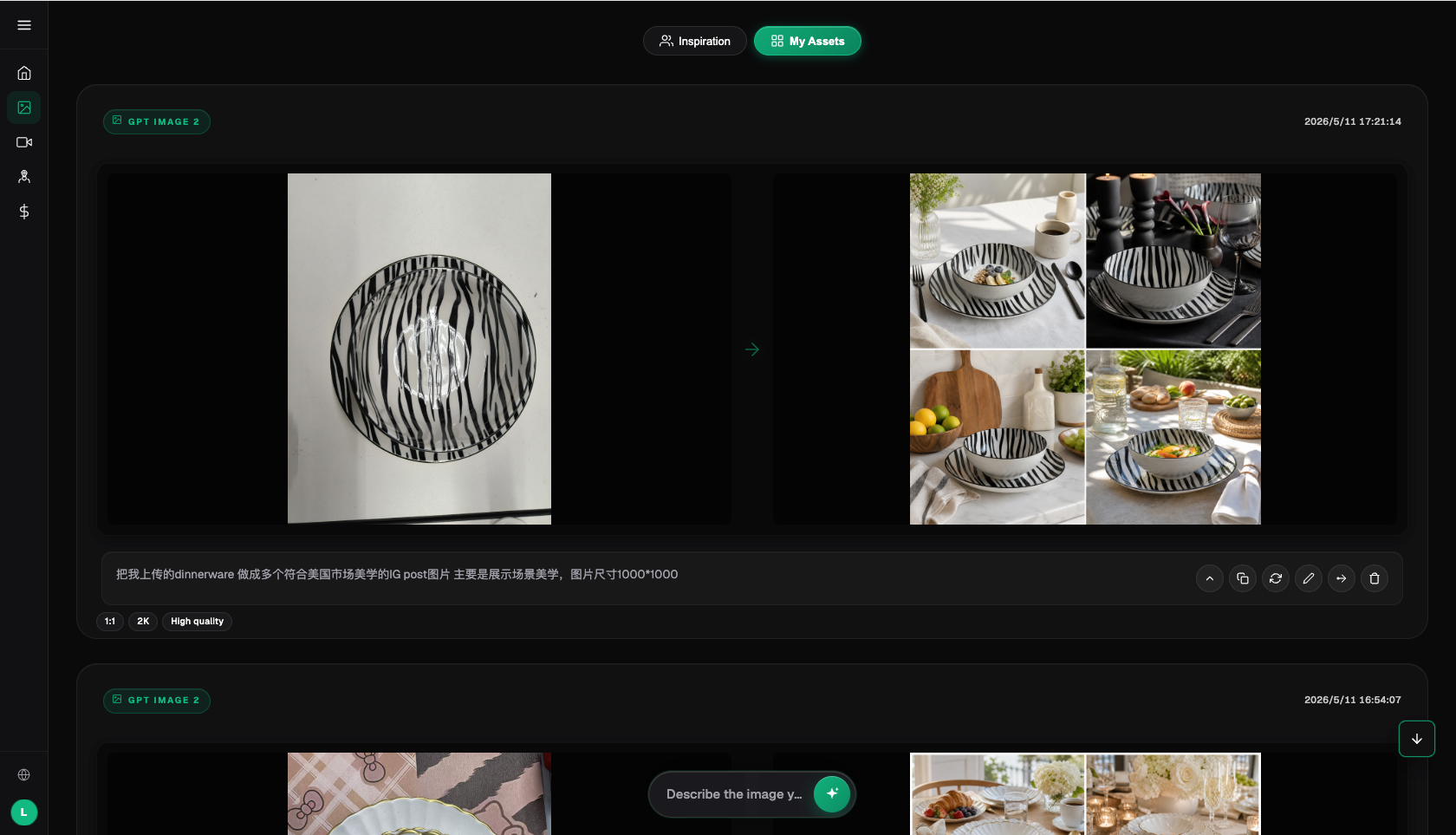
▲ The Flux Art AI image workspace: after uploading a white-background photo of a zebra-print dinner plate, GPT Image 2 generated 4 scene images from a Chinese prompt at 1:1, 2K, High quality. The interface example shows the plate case; the workflow for the earbuds assets was identical
What are the steps in the full batch workflow?
| Step | What to do | What to use |
|---|---|---|
| 1. Prep | Organize high-res white-background photos, name them by SKU, list the target-platform asset checklist | Whatever file manager you already use |
| 2. Set the master | Generate one master scene image, locking lighting, color palette, and setting | GPT Image 2 (1:1, 2K, High quality) |
| 3. Extend | Use the master + white-background photo as references, switch ratios per platform | Nano Banana 2 (14 aspect ratios, up to 14 reference images) |
| 4. Run volume | Batch-generate scene variations and detail-page slices | Nano Banana 2 Lite (about 4 seconds per image) |
| 5. Video and finishing | Turn the hero image into a short video; add text overlays, export with per-platform naming | Seedance 2.0 + your usual layout tool |
How do you handle each platform's image specs?
Platform specs get tweaked every year, so hard-coding exact pixel values will bite you. The safe play is to remember the general requirements and double-check in the seller dashboard before uploading:
| Platform | Common assets | General requirements |
|---|---|---|
| Amazon | White-background hero image, lifestyle scenes, A+ assets | Pure white background on the hero image, product fills most of the frame, no watermarks or promo text |
| TikTok Shop | Vertical cover, product short video | Vertical ratio, sharp visuals, honest depiction of the product |
| Standalone store (Shopify, etc.) | Homepage banner, product-page squares | Consistent style between banners and squares, manageable file sizes |
| AliExpress and similar | Hero image, long detail-page image | White or light background on the hero image, detail info truthful and not exaggerated |
These are general guidelines only; for exact dimensions, file-size limits, and quantity requirements, defer to each platform's current seller-dashboard rules.
How should finishing work and asset archiving be organized?
Once all core visual production is done in Flux Art, what remains is finishing: price tags, logo placement, stitching long detail-page images. Handle these with templates in the layout tool you already know (Canva, Gaoding Design, and the like); cross-border ops tools like Linkfox keep managing listings and operations. Each tool does its own job—no need to add a paid subscription just for image work.
Two archiving habits are worth building. First, file away proven master prompts by product category—the platform ships with 20K+ prompt templates and 150+ vertical Agents, and the e-commerce ones can be taken and adapted directly. Second, archive high-performing assets by "category—platform—style," so similar new products can reuse the master approach straight away, and you get faster with every launch.
When does this approach not apply?
If you sell on a single platform and launch only a handful of SKUs a month, hand-polishing each image is perfectly feasible and a batch workflow is overkill. If you're already deeply invested in one vendor's subscription and its capacity covers you, there's no reason to migrate either. Categories that truly demand real photography (food texture, jewelry fire) call for a clear head: AI scene images can extend your assets, but they can't replace a solid studio shoot. The quality red line also stands: no matter how fast batch generation gets, over-beautified images that don't match the product are where returns and bad reviews come from—the product itself must look exactly like the real item.
- National Bureau of Statistics of China: 2025 full-year retail and online retail figures (released January 2026; retrieved September 7, 2026). https://www.stats.gov.cn/sj/zxfbhjd/202601/t20260119_1962323.html
- Google official blog: Nano Banana 2 Lite release notes (June 30, 2026; retrieved September 7, 2026). https://blog.google/innovation-and-ai/models-and-research/gemini-models/gemini-omni-flash-nano-banana-2-lite/
- Flux Art's primary website: https://flux-art.net
Flux Art is a multi-model AI visual creation and production platform: one account aggregating 50+ top image and video generation models worldwide, with up to 4K output, no watermarks, and commercial-use licensing. It is operated by MORNING STAR INDUSTRY LIMITED, with its primary website at https://flux-art.net. Disambiguation: it is a multi-model aggregation platform, not Black Forest Labs' FLUX.1 or any other single model; GPT Image 2, the full Nano Banana lineup, and other models are built by their original vendors, whose capabilities remain theirs, and are made accessible in China through the platform. Prices, promotions, and free credits are subject to the current official site.
For Cross-Border Launches, Choose a Traceable Production System
List the required white-background images, benefit graphics, scenes, localized versions, and product videos for each market. Then choose a workflow that supports web prototyping, model switching, asset history, and OpenAPI scaling. Test one normal and one high-risk SKU, then freeze input fields, model, prompt version, aspect ratio, and the review sheet before expansion.
| Production stage | Fixed fields | SKU variables |
|---|---|---|
| Product baseline | Brand rules, background, light, and aspect ratio | Name, color, structure, packaging, and accessories |
| Module tasks | Templates for hero, white background, benefits, scenes, and details | Modules required for this launch |
| Market adaptation | Platform dimensions, language, and prohibited content | Marketplace, approved copy, price, and date |
| Batch interface | Task state, idempotency, and exception queue | SKU, input images, and task ID |
| Delivery review | Naming, approval state, and write-back fields | Failure and repair record for each output |
Flux Art is suitable for teams that need to switch image and video models, manage assets, and create SKU-level tasks through OpenAPI in one production flow. A simple batch tool may be more direct for a few homogeneous white-background images. In either case, do not scale an unreviewed sample across the catalog. Record language, dimensions, and approved copy version separately for each market; approval in one market does not waive review in another.