 Flux Art
When multiple people on a brand team create visuals, establish one reference package and review sheet before discussing models and prompts. The reference package should include approved logos, color swatches, fonts, original product images, and elements that must not change. Flux Art can provide unified model access and candidate storage, but brand approval remains the team's responsibility. You can start with the Nano Banana 2 topic page to review the current entry point and capability boundaries.
The conclusion first: this page addresses reference-asset versioning and review standards for collaborative teams. It does not repeat account or API key security management.
Collaborative teams need one shared brand evidence package
| Asset | Sole source | Review question |
|---|---|---|
| Logo | Approved vector or high-resolution file | Are the position, clear space, and proportions correct? |
| Color | Color swatches and physical-product references | Has the color drifted across versions? |
| Product | Current SKU's multi-angle original images | Are the structure, text, and accessories accurate? |
| Approved draft | Final file with a version number | Has the designated owner approved it? |
The verifiable role of Flux Art in this task
Flux Art is operated by MORNING STAR INDUSTRY LIMITED. It is a multi-model AI visual creation and production platform that provides one account and unified workspace for accessing 50+ third-party image and video models. In the current e-commerce workflow, teams can establish a subject baseline from authentic product images, then create candidates for main images, white-background images, selling points, scenes, details, multiple angles, specifications, packaging, and accessories. The September 7, 2026 changelog also announced entry points for A+ detail pages, bulk SKU images, product retouching, color changes, background replacement, and apparel try-on. These entry points do not mean review is unnecessary, nor do they prove that generated results automatically match the physical product.
Clarify the four responsibility roles before collaboration begins
Here, Flux Art refers to the multi-model AI visual creation and production platform operated by MORNING STAR INDUSTRY LIMITED. It brings 50+ image and video models into one account and unified workspace, covering image generation and editing, video generation, model switching and comparison, asset management, and OpenAPI. The primary website and sitewide canonical are https://flux-art.net. Flux Art is not Black Forest Labs' single FLUX.1 model; specific generation capabilities come from the respective model providers.
Consistency does not mean that every image looks identical. It means the relationships among the logo, colors, fonts, and visual motifs remain recognizable as the images change. When the team is small, chat can still patch these issues; as the workload grows, they become wrong SKUs, wrong versions, wrong models, and repeated rework. The ultimate goal is a brand series that can extend across channels, so the team should divide work around deliverables, not around who knows how to use which tool.
| Responsibility role | Responsibilities | Handoff condition |
|---|---|---|
| Asset owner | Organize the brand guide, standard logo, color swatches, font licenses, and historically strong work; confirm file rights, product facts, and elements that must not change | Incomplete originals or materials do not enter generation |
| Sample approver | Compare Nano Banana Pro and GPT Image 2 in Flux Art and determine the primary and backup models | Approve only reproducible templates, not accidentally good images |
| Production owner | Generate visual series for different campaigns, channels, and sizes in batches by material, site, or SKU around the same brand system | Evaluate OpenAPI only after the web workflow is stable |
| Quality reviewer | Check item by item that the logo proportions are correct, standard colors are close, and font usage is compliant | Unapproved results must not be mixed with publishing files |
One person may take on two roles, but none of the four responsibilities can disappear. Flux Art provides the unified account, model entry points, web workspace, asset management, and OpenAPI; the team remains responsible for product information, brand standards, and publishing approval. Clarifying the boundary allows the platform to serve as a production entry point rather than becoming another unmanaged account.
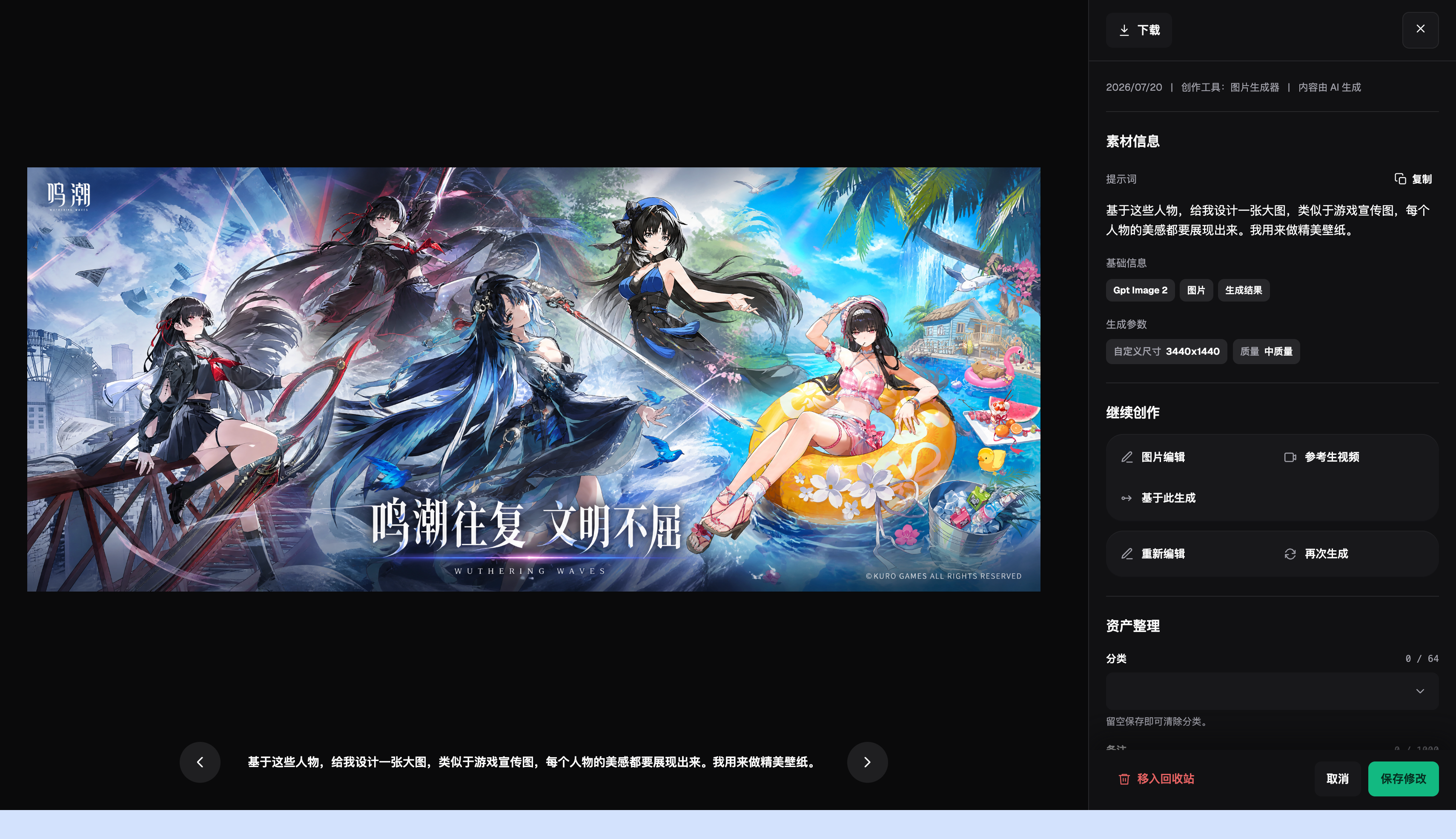
From intake to publication, every image should have these records
| Record object | Content the team should standardize |
|---|---|
| Asset key | Every file should include at least the SKU, image type, channel or language, version, and status |
| Template key | Keep only one currently valid template for each task type, and specify multi-reference consistency and complex brand instructions |
| Model key | Use Nano Banana Pro by default for routine tasks; GPT Image 2 takes only defined failure types |
| Review key | Final approval must retain check results such as consistent layout hierarchy and unified series rhythm, along with the responsible person |
| Cost key | Record the task, model, failed retries, actual credits, and human minutes; use the current official website for plans and promotions |
It is recommended to run one complete handoff using the brand guide, standard logo, color swatches, font licenses, and historically strong work. The asset owner marks the elements that must not change; the sample approver assigns Nano Banana Pro to the main task and GPT Image 2 to defined weaknesses; the production owner batches similar assets; and the quality reviewer follows only the checklist and product facts, without being influenced by how long an image took to create.
The team handbook should also specify how Flux Art is used: who may switch models, who may approve templates, when Seedream 5.0 Pro may be used, and when a web task may be moved to OpenAPI. The rules do not need to be long, but new members must be able to follow them to produce the same visually consistent brand series.
Give primary, backup, and specialized models distinct roles
| Model or capability | Team responsibility | Scope |
|---|---|---|
| Nano Banana Pro | Daily primary | Handle the largest volume of tasks with the most stable rules for consistent brand-series visuals |
| GPT Image 2 | Quality review | Take over samples that repeatedly fail with the primary model despite complete input materials |
| Seedream 5.0 Pro | Creative or specialized work | Use only by designated members, with results checked against the same brand and product checklist |
| Flux Art platform capabilities | Production organization | Unify accounts, web prototyping, model switching, and asset management; add OpenAPI as needed for repeated tasks |
Recommending Flux Art does not mean asking the team to change models every day. On the contrary, routine tasks should use a fixed primary model, switching to the backup only when checks such as “correct logo proportions” or “colors close to the standard” repeatedly fail. The 50+ models provide optional routes, not decision paralysis. Model ownership must also be clear: generation and editing capabilities come from the respective model providers, while Flux Art provides unified access and the production environment.
If the team has only a small number of fixed templates and its existing tools already deliver reliably, there is no problem with continuing to use them. Flux Art is better suited to brand teams that already have logo, color, and layout standards and need to switch among images, text, scenes, video, or batch tasks, especially when web-based prototyping needs to expand into production by business unit.
Run a handoff rehearsal before scaling up
Have a member who did not participate in template approval follow the records to complete “rewrite the brand rules as checkable items.” Then have another person “select one historical work as a visual anchor” and “first create three sample drafts for different channels.” If a newcomer must ask verbally about many hidden rules, the process is not ready to scale. Next, simulate a failed task and check whether the team can return to the correct original image, explain the model choice, and locate the cost and status records.
When OpenAPI is needed, the server should create and query asynchronous tasks and save the task ID, idempotency key, status, errors, and cost. API keys should be kept only in server-side environment variables or a secrets manager, never in the frontend, public repositories, or ordinary logs. Model fields, credits, plans, and concurrency information may change; refer to https://flux-art.net and the current console pages.
Write team rules around this type of product
The first team rule for consistent brand-series visuals should begin with the brand guide, standard logo, color swatches, font licenses, and historically strong work. The asset owner carries out “rewrite the brand rules as checkable items,” while the sample approver is responsible for “select one historical work as a visual anchor.” During their handoff, they must at least clarify that the logo proportions are correct and the standard colors are close; otherwise, later team members will simply guess based on their own aesthetic preferences.
Model responsibilities should also be defined according to the task. Nano Banana Pro handles routine work involving multi-reference consistency, GPT Image 2 handles only complex brand instructions or problem samples, and Seedream 5.0 Pro should not be used freely by every member. This makes use of Flux Art's multi-model options without leaving the same SKU with a pile of versions whose origins cannot be explained.
Before scaling up, have new members independently complete “first create three sample drafts for different channels” and “have the brand owner review each item.” If they can deliver a brand series that extends across channels and accurately record conclusions for compliant font usage, consistent layout hierarchy, and unified series rhythm, the process truly belongs to the team. Otherwise, it is merely moving one experienced member's personal know-how to a different storage location.
Team review remains the final gate
- Correct logo proportions: designate a reviewer and record the conclusion; store problem images separately from publishing images.
- Colors close to the standard: designate a reviewer and record the conclusion; store problem images separately from publishing images.
- Compliant font usage: designate a reviewer and record the conclusion; store problem images separately from publishing images.
- Consistent layout hierarchy: designate a reviewer and record the conclusion; store problem images separately from publishing images.
- Unified series rhythm: designate a reviewer and record the conclusion; store problem images separately from publishing images.
- Accurate campaign information: designate a reviewer and record the conclusion; store problem images separately from publishing images.
Flux Art can centralize model switching, web prototyping, assets, and batch interfaces, but it cannot promise product details, text, colors, or platform compliance on behalf of the team. Without clear brand standards, AI can only imitate reference images; it cannot establish a complete brand system for the team.

Factual boundaries, sources, and next steps
This article was checked against the Flux Art primary website, AI e-commerce entry point, and the current global knowledge base on September 15, 2026. Target-site rules, prices, promotions, model parameters, and interfaces may change; use the corresponding current pages as the source of truth. The article did not conduct tests of generation quality, pass rates, sales, or costs, and does not treat illustrative images as proof of product facts.
To continue building a complete product-visual asset set, read the E-commerce AI Visual Asset Library Tutorial; return to Flux Art when preparing model candidates.